
Unfinished Fathering

Good Morning, Bloomer!
Dead silence.
That’s what my aunt heard on her end of the phone line when I called my childhood home after my husband said my dad had died.
The phone was folded into my heaving belly as I tried to breathe.
Then came the sobbing.
It took some minutes before I could speak.
Yes, it was true.
No, he was still across the border in Canada at a relative’s cabin.
Yes, I should come home.
…
No, I was not alright.
This couldn’t be happening. My dad was only 56. I didn’t get to finish working out how to have a proper father-daughter relationship with him.
I thought we had more time.
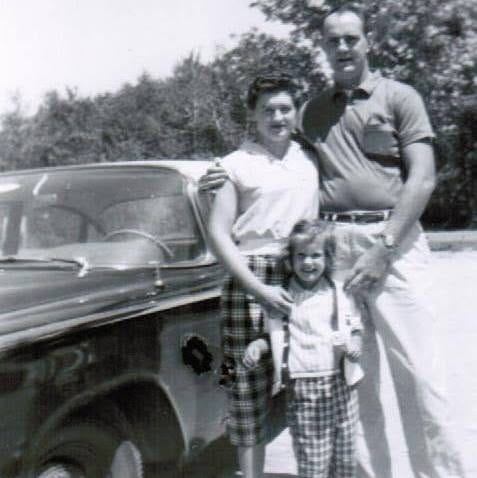
But it did happen. In 1988.
And I was left to mourn the connection between us that would never reach full bloom.
Which, as with many unfinished father-child relationships, also meant years of working to overcome self-esteem issues and a gnawing need for external validation.
But that started long before he died.
Dad was figuring it out, too.
I don’t think it occurred to Dad when he finally got Mom to marry him that he would so suddenly become a father.
I turned out to be a baby of the honeymoon conception variety.
And I’m pretty sure it created an unexpected learning curve.
Fortunately—or unfortunately, depending on who you ask—we lived alongside his parents in the six-flat they owned in Chicago. For a while, anyway. And so did Dad’s brother and his brand new family.
There were lots of parental sorts around to share the abundance of awkwardness and overwhelm.
Which must have done the trick because it wasn’t too many years later when my parents decided they’d got the parenting thing figured out enough to put a down payment on nirvana for the three of us in the south suburbs.
What I recall about that time was that I was either a spoiled brat (according to an aunt who babysat a time or two), a goody-two-shoes who was too big for her britches (according to an uncle whose house I had to stay at after school), or a disappointment who should have gotten more A’s on her report card (according to Dad).
There were good times, too. I’m sure there were.
I had my parents to myself for eight years.
But then, along came my two sisters. And that definitely put the kibosh on any bliss that may or may not have been going on for me.
It was many years after Dad died, when our mother died, that I discovered my sisters and I had two different sets of parents.
They got the benefit from the parenting practice Mom and Dad got with me.
I don’t know who got nirvana.
Assume positive fathering intent.
What I do know, though, with the benefit of hindsight, is that we all do the best we can with the cards we’re dealt.
Fathers included.

And I loved my dad.
I’m sad my father and I didn’t get to finish what we started.
And I’m really sad he never got to meet my son and his family.
Dad would marvel at what a father his grandson turned out to be. I can only guess that buried in our heritage somewhere are some really good dad seeds.
Because my son turned out to be the kind of father I would wish on every child. And—I’ve got to believe—the kind of father my dad truly wanted to be for me.
Maybe we’d have gotten there if he’d had the time to finish the job.
I hope you got to finish the job with your father. And that this Father’s Day was a tribute to a job well done.
If not, and he’s still around, don’t give up on it. Maybe some good dad seeds just need watering.
Keep Blooming 🌱
Barb
P.S. Did good dad seeds get watered in your life? I'd love to hear your story.
Will Wonders Never Cease?
Which outcome do you think is more likely predicted by a warm relationship between a boy and his father:
a) Greater professional success and higher income potential
b) Increased life satisfaction and less adult anxiety
If you chose a), the Harvard Grant Study (now called the Harvard Longitudinal Study of Adult Development) says you’re wrong.
It shows that the more likely predictor of professional success is a warm mother-son relationship.
The surprising impact fathers have, it turns out, is on their sons’ emotional well-being.
Some think it’s because, in the traditional setup, it’s mom who’s more often around dispensing discipline and work ethic, while dad shows up evenings and weekends for the fun stuff.
That could certainly explain why the men in the study with warm relationships with their dads liked to play and enjoyed their vacations more. And favored healthy coping mechanisms like humor to handle stress.
This landmark Harvard study is one of the longest-running studies of adult development in history, extending over 80 years. Which is remarkable given the challenges of longitudinal studies spanning generations.
The good news is that the study’s long-term findings demonstrate that early life experiences are not destiny. Damage from a difficult or distant father is fixable.
Which means the dad seeds that got planted for you—however imperfectly, however incompletely—can still bloom. And in the generations to come.
Read more about the Harvard study here:
https://www.forbes.com/sites/nextavenue/2013/11/05/why-your-childhood-is-crucial-to-how-youll-age/
https://fqmom.com/relationships-matter-harvard-longitudinal-study-adult-development/
https://www.theatlantic.com/magazine/archive/2009/06/what-makes-us-happy/307439/
Pun Intended
What’s a father who does chores?
A do-dad.
Beautiful story...thank you for sharing! pj